Why star clusters are different from other deep-sky objects
Star clusters are a bit different from other deep-sky objects. Most of them are beginner-friendly and can easily be captured in a single night, but some come with challenges.
When processing a nebula, you're usually trying to reveal as much of the faint detail while keeping the noise under control. With galaxies, the focus is on preserving the fine details in the spiral arms. Star clusters are different because your entire frame is made up of just stars. Some clusters are home to thousands of stars packed into a small area, with very bright stars in the center and much fainter ones around the edges.
The two most common issues you'll run into are blown-out cores in globular clusters, and images where there are so many stars that the cluster doesn't stand out from the surrounding field of stars. PixInsight has tools that can deal with these problems, and I'll cover them throughout the guide.
Open clusters Vs. Globular clusters: Processing differences
It's important to understand the difference between open clusters and globular clusters because the processing steps I use are slightly different.
Open clusters, like the Pleiades (M45), the Double Cluster (NGC 869 and NGC 884), or the Beehive Cluster (M44), are made up of young stars that formed together from the same cloud of gas and dust. The stars are spread out over a large area, and tend to blend into the surrounding star field. The goal when processing an open cluster is to make the cluster stands out without making the background stars distracting. For objects like the Pleiades, you also need to bring out the faint reflection nebulosity while keeping the bright stars under control.
 M44 is a typical open cluster.
Globular clusters are very different. Objects like M13, M15, and M22 are home to hundreds of thousands of very old stars packed tightly together. Their core is so bright to begin with that it can easily become overexposed, which will hide all the individual stars in the center. The key is to protect the core if you're trying to bring out the outer regions of the cluster.
You can also use a specific process to "see through" the overly bright core and reveal the individual stars in there.
Lastly, you can also do an HDR Combination using different exposure times (5 seconds, 15 seconds, 30 seconds...).
 Globular Cluster with 6 different exposure times
Fixing the globular cluster core
The blown-out core is the most common problem when it comes to globular cluster astrophotography. You can capture the beautiful M13 or Omega Centauri, run through your usual processing workflow, and end up with an impressive object that, on second look, lacks details near its core because of how much light it emits.
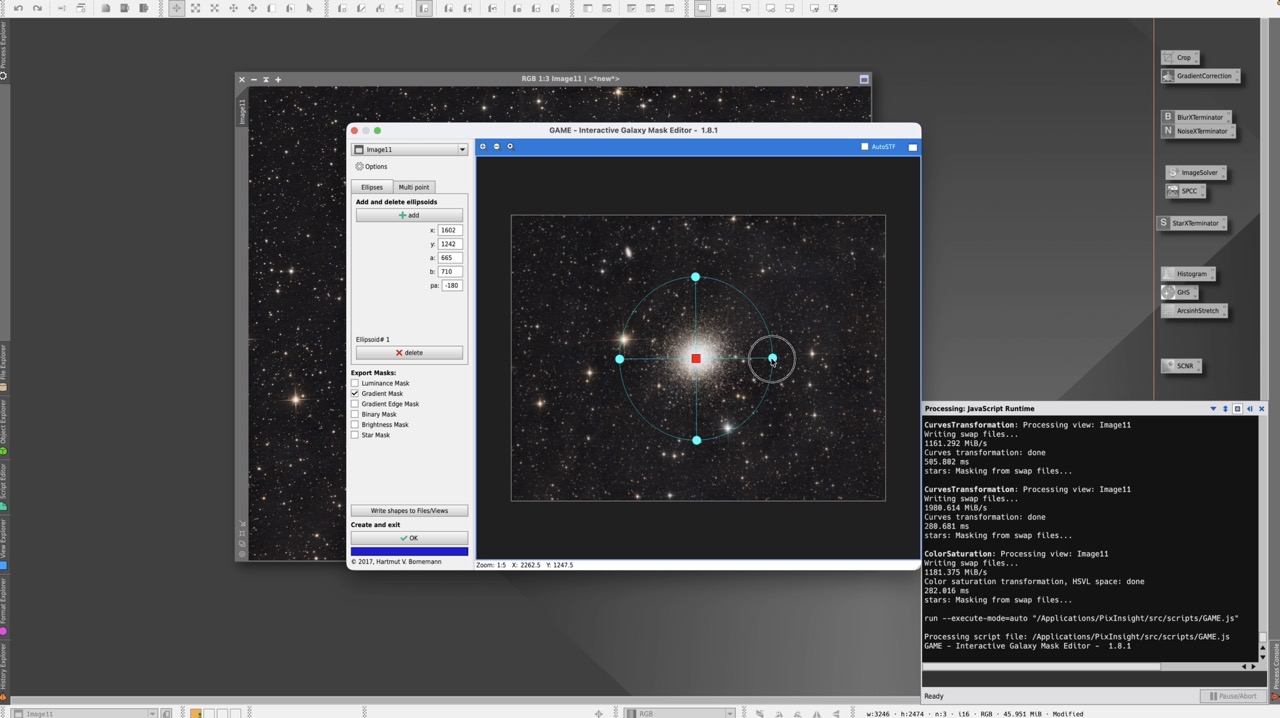
The guide dedicates an entire lesson specifically to fixing the core of your bright globular cluster. It also shows methods on other clusters in the case studies.
The Shapley-Sawyer concentration class: why it affects your processing
The Shapley-Sawyer Concentration Class is a scale from I to XII that classifies globular clusters by how densely packed their cores are.

A Class I globular like M75 (extremely concentrated) will have different core brightness compared to a Class X or XI cluster like M55. The more concentrated the cluster, the more careful you need to be with the core. If you know where your target falls on this scale before you start processing, you'll be able to know what to expect before you even start. A lesson covers the classification system and how to understand it.